
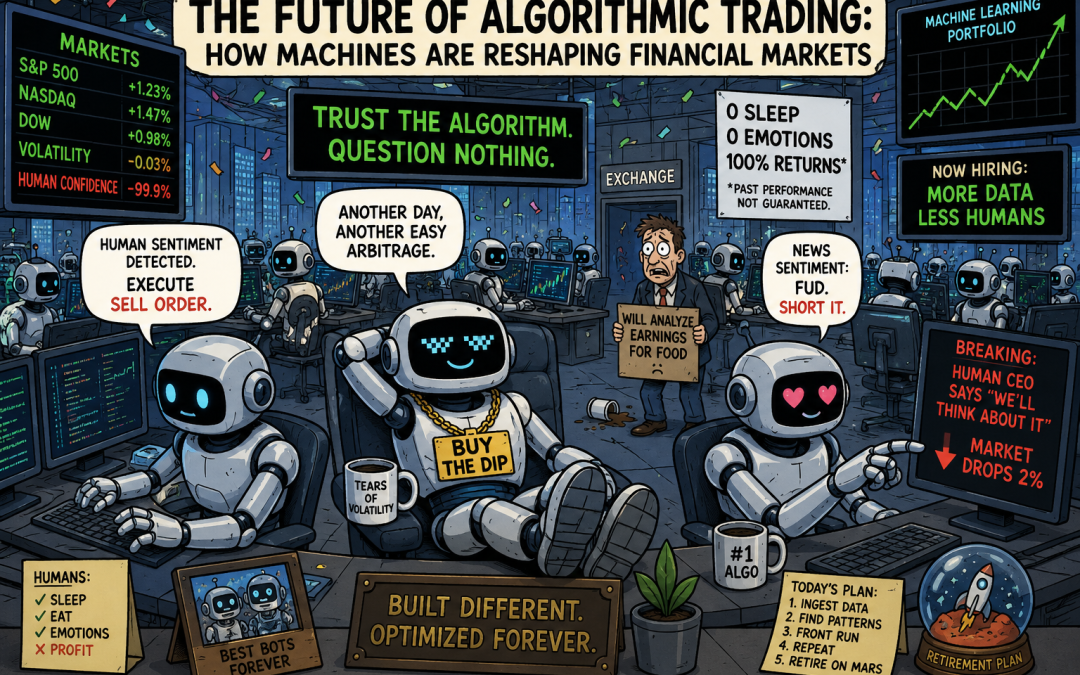
Financial markets have undergone a dramatic transformation over the past two decades. What was once a world dominated by human traders shouting orders across exchange floors has evolved into a highly automated ecosystem powered by algorithms, artificial intelligence, and high-speed computing.
Today, algorithmic trading, commonly known as algo trading, has become one of the most influential forces in global finance.
As technology continues to advance, many investors are asking the same question: what does the future of algorithmic trading look like?
What is Algorithmic Trading?
Algorithmic trading is the use of computer programs to execute trades automatically based on predefined rules. These rules can be based on factors such as price, volume, timing, market trends, volatility, or complex mathematical models.
Instead of a trader manually buying or selling a stock, an algorithm can monitor market conditions in real time and execute orders within milliseconds when specific criteria are met.
For example, an algorithm might be programmed to:
- Buy a stock when its 50-day moving average crosses above its 200-day moving average.
- Sell a position when losses exceed a certain threshold.
- Exploit tiny price differences between exchanges through arbitrage.
- Execute large institutional orders gradually to reduce market impact.
Modern algorithms can process massive amounts of data far faster than any human trader, making them an essential tool for hedge funds, investment banks, proprietary trading firms, and increasingly, retail investors.
Current Market Volumes and Adoption
Algorithmic trading is no longer a niche activity. In many developed markets, it accounts for the majority of trading activity.
Industry estimates suggest that algorithmic trading represents between 60% and 80% of equity trading volume in major markets such as the United States and Europe. High-frequency trading (HFT), a subset of algorithmic trading, contributes significantly to this volume by executing thousands of trades within fractions of a second. (Grand View Research)
The business behind algorithmic trading is also expanding rapidly. The global algorithmic trading market was valued at approximately $21 billion in 2024 and is projected to exceed $42 billion by 2030, growing at a compound annual growth rate (CAGR) of nearly 13%. (Grand View Research)
Several factors are driving this growth:
- Increased availability of market data.
- Faster computing power.
- Growth of cloud infrastructure.
- Expansion of AI and machine learning technologies.
- Greater access to algorithmic trading platforms for retail traders.
What was once reserved for large institutions is increasingly becoming accessible to individual investors through trading APIs, low-cost brokerage platforms, and automated strategy builders.
Advantages of Algorithmic Trading
1. Speed and Efficiency – Algorithms can analyse markets and execute trades in milliseconds. This speed enables traders to capitalise on opportunities that would be impossible for humans to identify and act upon manually.
2. Elimination of Emotional Bias – One of the biggest challenges in investing is emotional decision-making. Fear, greed, and panic often lead to poor trading outcomes. Algorithms follow predefined rules consistently, removing many psychological biases from the trading process.
3. Lower Transaction Costs – Automated execution can reduce trading costs by optimising order placement and minimising slippage. Institutions frequently use algorithms to execute large trades without significantly moving market prices.
4. Improved Risk Management – Modern trading systems can automatically enforce stop-loss limits, portfolio constraints, and position-sizing rules. This allows traders to manage risk more systematically.
5. Ability to Process Massive Data Sets – Advanced algorithms can evaluate news feeds, economic indicators, social sentiment, market depth, and historical price patterns simultaneously. This level of analysis is beyond human capability.
Challenges and Risks of Algorithmic Trading
Despite its advantages, algorithmic trading is not without drawbacks.
1. Technology Failures– System outages, coding errors, connectivity issues, and software bugs can cause substantial losses within seconds. Financial history contains several examples where faulty algorithms triggered significant market disruptions.
2. Increased Market Volatility – Some critics argue that algorithmic trading can amplify short-term volatility. During periods of market stress, multiple algorithms may react similarly, accelerating price movements.
3. Over-Optimisation – Many trading strategies perform exceptionally well during backtesting but fail in live markets. This occurs when algorithms are overly tailored to historical data rather than future market conditions.
4. Regulatory Challenges – As algorithmic trading becomes more sophisticated, regulators face increasing difficulty in monitoring market activity and preventing manipulation. Governments and exchanges worldwide continue to introduce regulations aimed at ensuring market stability and transparency. (The Economic Times)
5. Competitive Pressure – Successful algorithmic strategies rarely remain profitable forever. As more firms adopt similar technologies, market inefficiencies tend to disappear, reducing potential returns.
The Role of Artificial Intelligence
The next phase of algorithmic trading is being driven by artificial intelligence (AI) and machine learning. Traditional algorithms operate according to fixed rules. AI-powered systems, however, can learn from historical data, adapt to changing market conditions, and continuously refine their predictions. Machine learning models are increasingly being used for:
- Price forecasting.
- Sentiment analysis.
- Portfolio optimization.
- Risk management.
- Trade execution strategies.
The rapid growth of enterprise AI is expected to accelerate adoption across financial services as firms seek competitive advantages through better prediction and automation capabilities. (Reuters)
Leading quantitative firms are already investing heavily in AI infrastructure and research, demonstrating the strategic importance of machine learning in modern trading operations. (FNLondon)
What Does the Future Look Like?
The future of algorithmic trading will likely be defined by five major trends.
1. AI-Native Trading Systems – Future trading systems will increasingly rely on self-learning models capable of adapting to evolving market environments without constant human intervention.
2. Democratisation of Quantitative Trading – Retail investors will gain access to increasingly sophisticated tools previously available only to hedge funds and investment banks. Low-code and no-code strategy builders are already reducing barriers to entry.
3. Alternative Data Expansion – Algorithms will continue incorporating new forms of data, including satellite imagery, supply-chain information, consumer spending patterns, social media activity, and real-time economic indicators.
4. Greater Regulatory Oversight – As algorithmic trading grows, regulators are expected to implement stricter monitoring requirements, transparency standards, and risk controls to prevent systemic market disruptions.
5. Quantum Computing Potential – Although still in its early stages, quantum computing could eventually transform algorithmic trading by enabling faster optimisation, more advanced simulations, and improved predictive modelling capabilities. Early research is already exploring quantum-enhanced approaches for institutional trading applications. (arXiv)
Conclusion
Algorithmic trading has evolved from a specialised institutional tool into a cornerstone of modern financial markets. Its ability to execute trades rapidly, remove emotional decision-making, and process enormous volumes of information has fundamentally changed how markets operate.
While challenges remain, including technological risks, regulatory concerns, and increased competition, the long-term trajectory appears clear. The integration of artificial intelligence, machine learning, and eventually quantum computing will make trading systems more intelligent, adaptive, and data-driven than ever before.
Over the next decade, algorithmic trading is unlikely to replace human investors entirely. Instead, the most successful market participants will be those who effectively combine human judgment with increasingly sophisticated automated systems. In that sense, the future of trading is not human versus machine; it is human and machine working together.
Recent Comments