
Introduction
Artificial Intelligence (AI) has moved from being a futuristic concept to a core business strategy. Organisations across virtually every industry are investing heavily in AI technologies to improve efficiency, reduce costs, enhance customer experiences, and gain competitive advantages. From automating routine tasks to generating business insights in real time, AI is transforming how companies operate.
However, despite the excitement surrounding AI, many business leaders continue to ask a fundamental question: What is the return on investment (ROI) of AI integration?
Understanding the financial and strategic value of AI has become increasingly important as organisations allocate significant resources toward implementation. While AI offers enormous potential, achieving measurable returns requires careful planning, realistic expectations, and effective execution.
What Is AI Integration?
AI integration refers to the process of incorporating artificial intelligence technologies into business operations, products, services, or workflows. Rather than functioning as a standalone tool, AI is embedded into existing systems to improve decision-making, automate processes, and enhance productivity. Examples of AI integration include:
- Customer service chatbots
- Predictive analytics
- Fraud detection systems
- Recommendation engines
- Automated document processing
- Supply chain optimisation
- Predictive maintenance
- AI-powered marketing platforms
- Human resource screening tools
- Generative AI assistants
The objective is to create measurable business value through increased efficiency, improved accuracy, reduced operational costs, or enhanced revenue generation.
Current Market Size and Growth
The AI market has become one of the fastest-growing sectors in the global economy.
Industry analysts estimate that the global artificial intelligence market exceeded $250 billion in 2025 and could surpass $1 trillion by the mid-2030s. Businesses worldwide are accelerating investment as AI capabilities continue to improve.
Several factors are driving this growth:
- Generative AI Adoption – The rapid adoption of large language models and AI assistants has introduced AI to millions of businesses and consumers.
- Enterprise Digital Transformation – Companies are increasingly integrating AI into core business processes to improve productivity and competitiveness.
- Cloud Computing Infrastructure – Cloud providers have made AI tools more accessible and scalable, reducing barriers to adoption.
- Data Availability – The explosion of digital data provides the fuel AI systems need to generate insights and predictions.
- Competitive Pressure – Many organisations fear being left behind if competitors successfully deploy AI technologies first.
As a result, AI spending is becoming a strategic priority across industries ranging from healthcare and finance to manufacturing and retail.
Understanding AI ROI
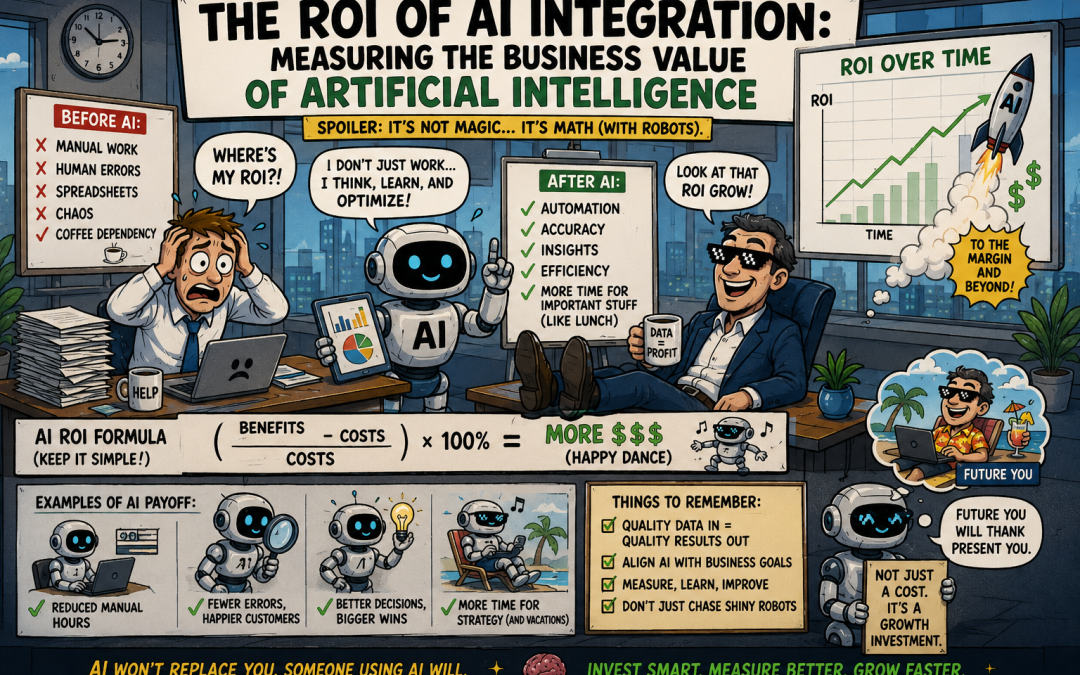
Return on investment (ROI) measures the financial benefit generated from an investment relative to its cost.
In simple terms: ROI = (Gain from Investment – Cost of Investment) ÷ Cost of Investment × 100
When applied to AI, ROI can be measured through:
- Revenue growth
- Cost reduction
- Productivity improvements
- Customer retention
- Operational efficiency
- Risk reduction
- Faster decision-making
Unlike traditional technology investments, AI often delivers both direct financial returns and indirect strategic benefits.
Benefits of AI Integration
There are several benefits.
- Increased Productivity – One of the most immediate benefits of AI is automation. AI systems can handle repetitive tasks such as data entry, Scheduling, Customer support, Report generation and Invoice processing. This allows employees to focus on higher-value activities, significantly increasing overall productivity.
- Cost Savings – AI can reduce operational expenses by automating labour-intensive processes and minimising human error. For example, (a) Automated customer service reduces support costs, (b) Predictive maintenance lowers equipment downtime, and (c) AI-driven logistics optimise transportation expenses. Over time, these savings can generate substantial ROI.
- Better Decision-Making – AI systems can analyse enormous datasets in real time and identify patterns that humans may overlook. Businesses can use these insights to (a) improve forecasting, (b) Optimise pricing strategies, (c) identify market opportunities, and (d) manage risk more effectively. Data-driven decisions often lead to stronger financial performance.
- Enhanced Customer Experience – AI enables highly personalised customer interactions; for example, Product recommendations, Personalised marketing campaigns, Intelligent virtual assistants and Faster support response times. Improved customer experiences often lead to higher retention rates and increased revenue.
- Competitive Advantage – Organisations that successfully deploy AI can gain advantages in speed, efficiency, innovation, and customer service. In highly competitive industries, these benefits can significantly impact market share and profitability.
Challenges and Drawbacks of AI Integration
Despite its potential, AI integration is not without risks and challenges.
- High Initial Investment – Implementing AI often requires substantial upfront spending on Software platforms, Infrastructure, Data management, Training, Consulting services and Skilled personnel. For some organisations, the costs may delay ROI realisation.
- Data Quality Issues – AI systems are only as good as the data they use. Poor-quality data can result in Inaccurate predictions, Biased outcomes and Inefficient processes. Organisations frequently underestimate the effort required to prepare and maintain clean data.
- Talent Shortages – Demand for AI specialists continues to exceed supply. Finding qualified professionals in areas such as machine learning, data science, and AI engineering can be expensive and difficult.
- Integration Complexity – Many businesses operate legacy systems that were not designed to support AI technologies. Integrating AI into existing workflows can be technically challenging and time-consuming.
- Ethical and Regulatory Concerns – AI adoption raises important questions regarding Data privacy, Transparency, Bias, Accountability and Intellectual property. Organisations must navigate evolving regulations while ensuring responsible AI usage.
Measuring Successful AI ROI
Not every AI project delivers positive returns.
Successful organisations typically focus on clear business objectives rather than adopting AI simply because it is fashionable.
Key indicators of AI success include:
- Productivity Metrics – Time saved per task, Employee efficiency improvements and Reduced manual workload
- Financial Metrics – Revenue growth, Cost reductions and Profit margin improvements
- Customer Metrics – Customer satisfaction scores, Retention rates and Conversion rates
- Operational Metrics – Reduced downtime, Faster processing times and Improved forecasting accuracy
The most effective AI initiatives often begin with specific, measurable business problems rather than broad technology ambitions.
The Future of AI ROI
The future of AI integration is expected to deliver even greater returns as technologies mature. Several trends are likely to drive future ROI growth.
- AI Becoming More Affordable – As competition increases among AI providers, costs are expected to decline. This will make advanced AI capabilities accessible to smaller businesses and mid-sized enterprises.
- Industry-Specific AI Solutions – Future AI platforms will become increasingly specialised for sectors such as healthcare, legal services, manufacturing, finance, and retail. Specialised solutions typically generate higher ROI because they address specific business challenges more effectively.
- Autonomous Business Processes – AI will increasingly move beyond assisting humans to managing entire workflows autonomously. Examples may include: Automated procurement, Autonomous customer support, Self-optimising supply chains and AI-driven financial analysis. This shift could dramatically increase productivity and cost savings.
- AI-Human Collaboration – Rather than replacing workers entirely, future AI systems are likely to function as highly capable assistants. Employees will use AI to enhance creativity, problem-solving, and decision-making, creating a multiplier effect on productivity.
- Improved Measurement Frameworks – As AI adoption matures, businesses will develop more sophisticated methods for tracking and quantifying ROI. This will improve investment decisions and increase confidence in AI initiatives.
Conclusion
Artificial intelligence is rapidly becoming one of the most valuable technologies in modern business. While implementation can require significant investment, successful AI integration often delivers substantial returns through increased productivity, reduced costs, improved customer experiences, and better decision-making.
The global AI market continues to grow at an extraordinary pace, driven by advances in machine learning, generative AI, cloud computing, and automation. Organisations that strategically integrate AI into their operations are increasingly gaining competitive advantages and unlocking new sources of value.
However, achieving strong ROI requires more than simply adopting the latest technology. Businesses must focus on clear objectives, high-quality data, effective implementation, and measurable outcomes.
As AI becomes more affordable, accessible, and powerful, its return on investment is likely to increase significantly. For many organisations, the question is no longer whether to invest in AI, but how quickly they can deploy it effectively and capture the benefits before competitors do.
Recent Comments