
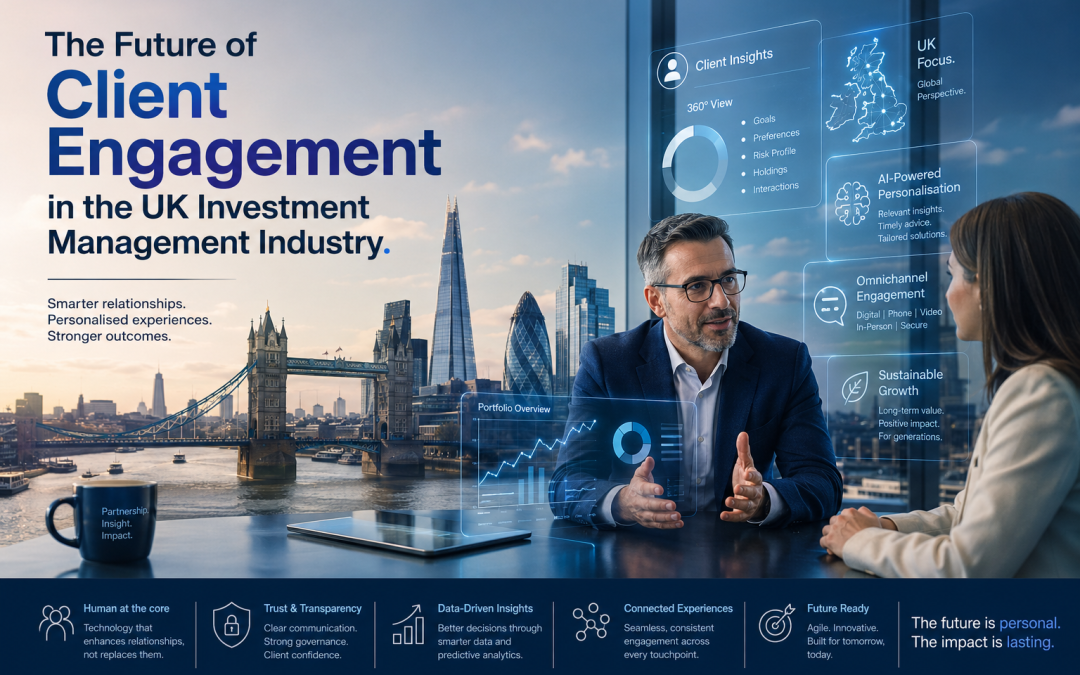
The investment management industry is experiencing one of the most profound shifts in its history. Traditional models of client engagement have been built on periodic meetings, quarterly statements, and face-to-face interactions, but they are being toppled by digital transformation, rising investor expectations, and generational change.
Clients today expect personalised, transparent, and always-on engagement, in a similar manner to what they experience with technology firms.
Also, firms face the dual challenge of maintaining trust and delivering consistent value in an increasingly data-driven, regulated, and competitive environment.
The question is no longer whether client engagement needs to evolve, but how investment managers can transform it to meet the demands of the next decade.
What is the new engagement model?
For decades, client engagement in investment management was built around products and performance.
Success meant delivering alpha and meeting benchmark targets, but as markets mature and passive products commoditise returns, clients now judge their managers on a broader experience, such as empathy, transparency, education, and accessibility.
This shift mirrors trends in other industries where consumers expect financial relationships to be interactive, intuitive, and value-driven. In a recent Deloitte survey, over 70% of wealth management clients said they value ongoing communication and tailored advice more than outperformance alone.
Therefore, the new frontier of engagement is experiential, which means focusing not only on outcomes but on how clients feel about their journey.
Investment managers who master this will redefine loyalty in an era of choice and competition.
Digital Acceleration of Client Relationships
Digital transformation has moved from an operational necessity to a strategic differentiator.
Since the COVID-19 pandemic, clients have grown familiar with seamless digital interactions across every aspect of their financial lives. This has only accelerated a paradigm shift in how engagement is delivered.
Seamless integration and multiple channels.
Modern clients expect to engage on their terms, whether this is via video calls, chat, email, or apps.
The most successful firms are adopting omnichannel engagement, where clients can transition effortlessly between digital and human touchpoints.
A client might review portfolio insights in an app but then schedule a video review with their adviser, and later receive a tailored follow-up report. An all-encompassing and consistent experience.
This hybrid approach does not replace personal advice, but it enhances it because it allows advisers to focus on value-added conversations rather than administrative updates.
Data-driven Personalisation.
Data is becoming the heartbeat of engagement.
Using analytics and AI, firms can build detailed client profiles covering not just financial details, but behavioural dynamics.
Therefore, let us imagine a system that notices a client checking ESG fund performance more frequently, and then proactively sends them an educational insight on sustainable investing. That is proactive engagement, which has been powered by predictive analytics.
Investment managers are increasingly leveraging CRM systems, sentiment analysis, and client segmentation to anticipate needs and deliver relevance at scale.
Digital Portals and Dashboards.
Investor portals are evolving from static reporting platforms to interactive engagement hubs.
Today’s dashboards integrate real-time performance tracking, scenario modelling, risk visualisation, and even ESG impact metrics.
Clients no longer want quarterly PDFs, but they want instant access to their financial story.
The best digital tools empower clients to explore, learn, and make informed decisions in partnership with their adviser.
Human Advice in a Digital Age
While technology is transforming engagement, the human element remains irreplaceable.
Investment decisions are emotional as much as analytical, which means that trust is still built through human relationships.
The future of client engagement lies in augmenting, not replacing, human advice.
This means that digital tools will handle the data, automation, and personalisation, with advisers focusing on empathy, context, and judgment. This creates a new model (which we can call “the augmented adviser”) which is empowered by technology but grounded in humanity.
Empathy as a differentiator.
In an age where AI can model markets but not emotions, empathy becomes the ultimate differentiator.
Clients want advisers who understand their aspirations, fears, and values and not just their risk profiles. This means shifting the conversation from “What’s your return target?” to “What matters most to you, and how can your investments enable that?” This purpose-driven engagement helps build trust and longevity.
Coaching and not just advising.
Modern investors increasingly seek coaching covering ongoing support, education, and empowerment. Investors value advisers who explain volatility, help manage behavioural biases, and build confidence over time.
By acting as coaches (rather than pure consultants), investment professionals can foster resilience and deepen engagement. This is especially true among younger clients navigating their first major investment cycles.
Engaging the next wave of investors.
A generational wealth transfer estimated at over £5 trillion is expected to pass to younger UK investors over the next two decades.
But despite this, many investment firms still struggle to connect with this emerging audience.
Younger investors (covering Millennials and Gen Z) bring very different expectations to other generations. They prioritise values, technology, and experience over legacy prestige.
Purpose and Values Matter
Sustainability, diversity, and ethical investing are no longer niche preferences.
According to Schroders’ Global Investor Study, more than 60% of UK investors under 40 consider sustainability a core part of their investment decisions.
This means that for this demographic group, client engagement must go beyond performance updates. It will need to cover purpose alignment, or, in other words, show how the firm’s actions reflect clients’ social and environmental priorities.
Digital-First Expectations.
The next generation of investors has grown up in an app-driven world, where they expect (or even demand) 24/7 access, intuitive interfaces, plus personalised content.
This does not mean abandoning human advice, but it does require rethinking delivery along the lines of mobile-first design, on-demand video briefings, and interactive content for engagement.
Education as Engagement
Younger clients often have high curiosity but low confidence in investing.
This means that firms that offer educational engagement (say via webinars, explainers, and digestible financial literacy content) will win loyalty early and position themselves as trusted partners for decades.
Trust, Transparency and Regulation.
Trust remains the currency of investment management. However, in the digital era, it must be earned continuously through transparency, ethical behaviour, and communication clarity.
Real-time Transparency
Clients increasingly expect full visibility into fees, performance, and risk exposure.
The UK FCA’s Consumer Duty and Sustainability Disclosure Requirements (SDR) have reinforced this trend by pushing firms to communicate with honesty and clarity.
Firms that adopt proactive disclosure and open data-sharing (for example, interactive fee breakdowns or ESG impact dashboards) can transform compliance into a trust-building advantage.
Authentication and Communication Tone
Clients can sense marketing jargon a mile away.
The most engaging firms are authentic, and this can be done by using plain language, clear narratives, and relatable examples.
It is key to remember that clients don’t want to be “sold to”, they want to be understood. Therefore, tone is paramount.
Therefore, regular, transparent communication (especially when markets are volatile) is one of the strongest drivers of long-term trust.
AI to Automation to fuel predictive engagement.
Artificial intelligence is reshaping how investment managers understand and interact with clients. The most forward-looking firms are using AI not just for trading algorithms, but for relationship intelligence.
Predictive Insights
AI can analyse patterns in client behaviour. This can range from login frequency to portfolio adjustments. This insight can then flag when engagement is waning or concern is rising.
This enables advisers to intervene proactively, turning potential churn into conversation.
Natural Language Generation (NLG).
AI-driven tools can produce personalised performance summaries or market updates, which will free up advisers to focus on deeper dialogue.
This means that a quarterly report could automatically include bespoke insights based on a client’s holdings and goals.
Compliance Automation.
Automation is also improving compliance oversight, therefore ensuring that communications meet FCA standards while maintaining a personal touch. The result is faster, safer, and more consistent engagement.
However, there is a balance to this. AI should enhance understanding but not erode it. The future belongs to firms that blend intelligence with intuition.
As engagement evolves, so must the metrics by which firms measure success.
The traditional indicators (of AUM growth, retention rates, or net new money) will tell only part of the story.
Tomorrow’s leaders will track engagement depth, not just frequency; namely:
- Client sentiment and satisfaction via ongoing feedback loops.
- Digital engagement analytics, such as portal usage and content interaction.
- Client advocacy and referrals as indicators of trust.
- Education participation, such as which webinars, surveys, or tools are used.
These insights create a virtuous cycle where understanding engagement drives better service, which in turn deepens engagement further.
Building a culture of continuous engagement
Client engagement is not just a communications function; it is a cultural capability.
This means that to sustain relevance, investment managers must embed client-centricity across the organisation.
Breaking down silos.
Front-office, marketing, operations, and compliance teams all influence engagement. The future demands integrated teams that share client insights, ensuring consistent experiences across every touchpoint.
Empowering Staff
Advisers and support teams must be equipped with data, tools, and training to engage meaningfully. Empowerment breeds ownership and ownership breeds better client outcomes.
Feedback-Driven Progression..
Firms should treat engagement as a two-way dialogue by continuously gathering client feedback and then adapting services accordingly. Listening is no longer optional; it is essential.
Engagement as a competitive edge
As technology advances and investor demographics evolve, the future of client engagement will be defined by the following three principles:
- Personalisation at Scale – Leveraging data and AI to tailor experiences while maintaining a human touch.
- Purposeful Transparency – Making trust measurable through openness, ethics, and clarity.
- Human-Centred Innovation – Designing technology that deepens, not diminishes, relationships.
Firms that succeed will not just manage assets. They will manage relationships for life.
Engagement will become a source of competitive differentiation, loyalty, and advocacy.
It will determine which firms thrive in an era where clients can switch providers with a swipe but stay for decades if they feel truly understood.
Conclusion
The future of client engagement in investment management is hybrid, data-driven, and human at its core.
Technology will deliver efficiency and personalisation; advisers will deliver empathy and trust.
Together, they will redefine what meaningful engagement looks like.
For firms that embrace this evolution, the rewards are profound with deeper loyalty, stronger differentiation, and a brand built not just on performance, but on enduring partnership.
In the next decade, client engagement will be a department because it will be the heartbeat of every successful investment firm.
Recent Comments