
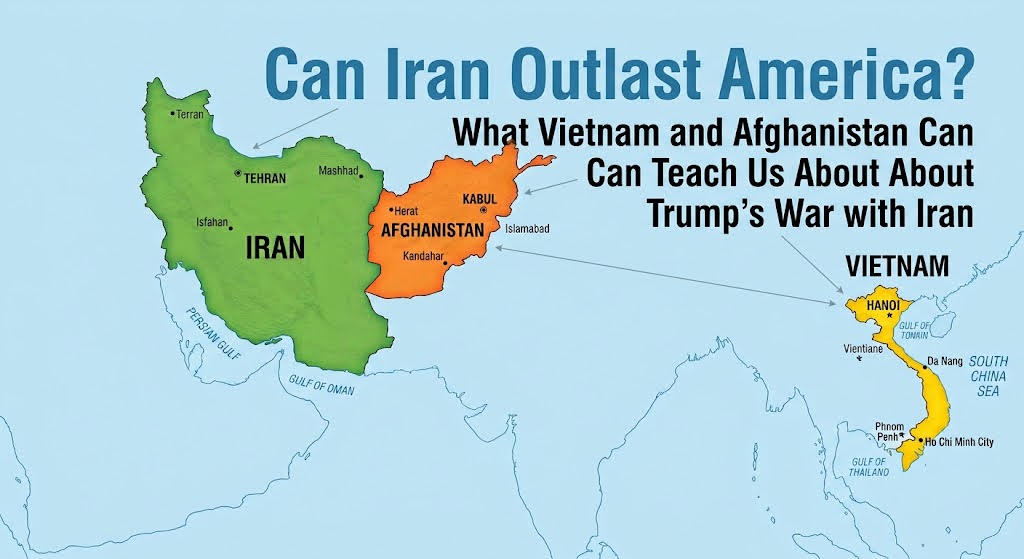
What Vietnam and Afghanistan can teach us about Trump’s war with Iran
There is a temptation, when looking at the war between the United States and Iran, to focus on the obvious question: who is winning militarily?
On that measure, the answer seems relatively straightforward. The United States possesses overwhelming advantages in air power, intelligence, naval capability, logistics and precision weapons. Iran cannot realistically defeat America in a conventional military contest.
Yet history tells us that wars are rarely decided by military capability alone.
The more important question is whether military superiority can actually be translated into political victory.
That distinction is particularly important when considering Vietnam and Afghanistan, two conflicts in which the United States possessed enormous military advantages but ultimately failed to achieve its wider political objectives. In both cases, the opposing side did not necessarily have to defeat America militarily. It needed to survive, maintain its objectives and wait for American political support and public patience to weaken.
That raises a fascinating question about Iran: is Tehran attempting to do something similar to Donald Trump?
The comparison should not be overstated. Vietnam, Afghanistan and Iran are fundamentally different conflicts. Vietnam was a Cold War struggle involving North Vietnam, the Viet Cong and the wider confrontation between communism and the West. Afghanistan became a twenty-year counter-insurgency following the attacks of 11 September 2001. Iran is a large sovereign state with a population of around 90 million, a substantial military-industrial base, ballistic missiles, drones, naval capabilities and extensive regional influence. Iran is therefore a much more capable opponent than the Taliban.
Nevertheless, there is a common strategic thread: the weaker side does not necessarily have to defeat America; it may simply have to survive long enough for America to lose the political will to continue.
The lesson of Vietnam
Vietnam remains the classic example of the limits of military power.
The United States deployed enormous resources and inflicted devastating losses on North Vietnamese and Viet Cong forces. American forces possessed overwhelming advantages in air power, artillery, intelligence and logistics, yet the United States eventually withdrew without achieving its fundamental political objective.
North Vietnam understood that it did not need to destroy the American military. It needed to maintain resistance and wait. Every additional year created more American casualties, greater financial costs and increasing political division. The 1968 Tet Offensive illustrated this perfectly. Militarily, Tet was a major setback for the Viet Cong, but politically it undermined American confidence in the government’s claim that victory was approaching.
The question increasingly became not “Can America win?” but “Is winning worth the cost?”
That was the critical shift. America remained the stronger military power, but its political freedom to use that power was gradually reduced. Vietnam demonstrated that military superiority does not necessarily produce strategic victory if the opponent can make the war politically unsustainable.
Afghanistan: the power of simply surviving
Afghanistan reinforced the same lesson.
When the United States invaded in 2001, the Taliban government was defeated remarkably quickly. American and allied forces achieved an overwhelming military victory. But defeating the Taliban was not the same as creating a stable Afghan state capable of surviving without American support.
The Taliban therefore changed strategy.
They did not need to defeat American forces in conventional battle. They could retreat, regroup, recruit and conduct an insurgency. Most importantly, they could wait. America had elections, changing presidents, changing public priorities, enormous financial costs and military casualties.
The Taliban had one overriding objective: survive.
Twenty years later, America withdrew, and the Taliban returned to Kabul. It would be misleading to say that the Taliban militarily defeated the United States. They did not. The more accurate conclusion is that America eventually decided that achieving its objectives in Afghanistan was no longer worth the cost of continuing to fight.
That distinction matters enormously when thinking about Iran.
Iran: a much more dangerous opponent
Iran is a fundamentally different adversary. Unlike the Taliban, it is a sovereign state with a large population, significant industrial capacity and sophisticated military capabilities. It possesses ballistic missiles, drones, naval forces and extensive regional relationships. It can therefore impose genuine costs on the United States and its allies.
But Iran also has something particularly important: the Strait of Hormuz.
This gives Tehran a potential economic weapon that neither Vietnam nor Afghanistan possessed to the same degree. If shipping through Hormuz remains seriously disrupted, the consequences extend far beyond the battlefield. Higher oil prices can lead to higher petrol prices, greater inflationary pressure and increased household costs. Those economic consequences can then become political consequences.
The chain is straightforward: Hormuz disruption leads to higher energy prices, which increase economic pressure, which can reduce public support for the war, which increases political pressure on Trump.
Iran therefore does not necessarily need to defeat American aircraft or destroy American naval forces. It may simply need to keep the conflict expensive enough for Americans to question whether continuing is worthwhile.
Iran may not need to win.
This may be the most important element of Tehran’s potential strategy. Iran cannot realistically expect to defeat the United States conventionally. But perhaps that is not the objective.
Instead, Iran may be trying to make an American victory increasingly difficult to define. Trump can destroy Iranian military infrastructure, weapons and strategic facilities, but if Iran continues fighting, what exactly constitutes victory?
If Tehran refuses to surrender, Trump cannot easily claim that Iran has surrendered.
If Iranian forces continue imposing costs, the war continues. And if the war continues, American casualties, economic costs and political pressure accumulate.
Iran’s strategy could therefore be to survive, preserve sufficient military capability to continue resisting, maintain pressure around Hormuz, keep diplomatic channels open and avoid giving Trump an overwhelming justification for unlimited escalation. In simple terms:
Iran does not necessarily need to beat America. It may only need to outlast it.
The November 2026 problem
The approaching November midterm elections make this calculation particularly interesting. Iran does not have to assume that the war will end because of the election. It only has to recognise that an unresolved war becomes increasingly politically expensive as November approaches.
Imagine the situation in October: America remains overwhelmingly more powerful militarily, Iran is heavily damaged but undefeated, Hormuz remains problematic, oil prices remain high, casualties have accumulated, and there is still no clear political settlement. At that point, the war itself becomes an American political issue.
Republican politicians begin worrying about their seats. Voters become more concerned about petrol prices and inflation. Democrats argue that Trump promised a decisive victory but instead created another prolonged Middle Eastern war. Trump then faces an uncomfortable choice. Continuing the war may maintain pressure on Iran but risk greater casualties, higher prices and further political damage. Negotiating may reduce those costs but create the appearance that Iran resisted Trump’s demand for surrender.
This is particularly difficult for Trump because his political identity is strongly associated with strength and winning. The more he insists that Iran must surrender, the harder it becomes to negotiate a compromise without appearing to back down.
But Iran could get this badly wrong.
There is a major danger in assuming that political pressure will automatically force Trump towards negotiation. He may respond to Iranian resistance by escalating instead.
The sequence could therefore become: Iranian resistance leads to greater American pressure; greater pressure produces Iranian retaliation; retaliation produces further American escalation; and the conflict becomes wider and more dangerous.
That is why the situation involving Oman is potentially so worrying.
Oman has traditionally played an important diplomatic role between Washington and Tehran. If Washington begins treating Omani involvement as obstruction rather than mediation, one of the channels through which the conflict might eventually be resolved could itself become part of the confrontation.
The greatest danger is therefore a conflict that neither side necessarily wants to expand but in which neither side feels able to be the first to compromise.
So is Iran repeating Vietnam and Afghanistan?
Not literally. Iran is not following a Vietnamese or Afghan blueprint. But the underlying principle is remarkably similar.
Vietnam demonstrated that America can win battles while losing the wider political war.
Afghanistan demonstrated that a much weaker opponent can survive long enough to outlast American political patience.
Iran may now be attempting to combine elements of both strategies while adding something particularly powerful: the ability to influence global energy markets.
The real battlefield may therefore be larger than the Middle East. America and Iran are fighting militarily, but they are also fighting over American public opinion. Iran can lose military equipment and continue fighting. Trump can destroy Iranian infrastructure and still face falling approval. Iran can survive another month. Trump has to survive an election.
That creates a fundamental asymmetry.
The question that will decide the war
Ultimately, the question is not whether America can defeat Iran militarily. It almost certainly can inflict enormous damage. The real question is whether America can force Iran to accept its political objectives before the cost of continuing the war becomes greater than the benefit of winning it.
Vietnam shows what happens when military power cannot produce political surrender.
Afghanistan shows what happens when an opponent is willing to wait longer than America is willing to fight.
Iran may now be attempting to combine elements of both strategies while using geography, diplomacy, military resistance and energy markets to increase the political pressure on Washington.
The irony is that Iran may not need to win the war. It may only need to avoid losing it.
If it can remain sufficiently intact and keep the conflict unresolved as November approaches, the centre of gravity of the war could gradually shift from Tehran to Washington. The United States may remain the overwhelmingly stronger military power while simultaneously becoming the side under greater political pressure to find a way out.
And that may leave Donald Trump facing the most uncomfortable question of all:
What do you do when you have the world’s most powerful military, but the enemy’s greatest weapon is simply the ability to keep fighting?
That is the lesson of Vietnam.
That is the lesson of Afghanistan.
And it may ultimately be the lesson of Iran.
Recent Comments