
Introduction
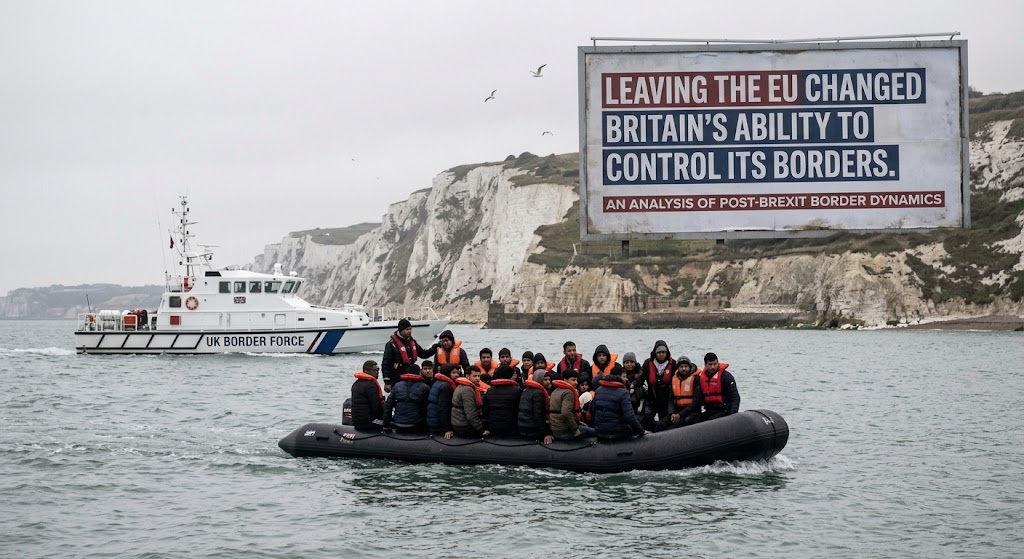
Brexit was, above all, about taking back control, particularly control of Britain’s laws, borders and immigration. Yet one of the most striking developments since Brexit has been the growth of small-boat crossings across the English Channel and the continuing difficulty successive governments have had in stopping them.
It would be wrong to say that Brexit caused the small-boats crisis. The crossings began in significant numbers in 2018, before Britain had left the EU, and were driven by a combination of international migration, wars, people-smuggling networks, geography and increasingly difficult alternative routes into Britain.
However, Brexit did change something important: the mechanisms available to Britain for managing people who arrived from Europe.
What Changed After Brexit?
Before Brexit, Britain participated in the EU’s Dublin III arrangements, which provided a framework for determining responsibility for asylum claims and, in certain circumstances, transferring asylum seekers between European countries. It was never a perfect system; actual transfers were relatively limited, but it was an established mechanism for European cooperation.
When the Brexit transition period ended in December 2020, Britain left Dublin III and did not secure an equivalent EU-wide replacement.
This happened just as the small-boats route was growing rapidly. Arrivals rose from around 300 in 2018 to approximately 8,500 in 2020, 28,500 in 2021 and 46,000 in 2022.
The timing does not prove that Brexit caused the boats.
The route was already expanding. But Brexit meant that Britain was dealing with a rapidly growing problem without one of the European mechanisms it had previously used to manage asylum cases.
That is the real paradox.
Sovereignty Is Not the Same as Control.
Brexit gave Britain greater legal sovereignty over immigration. But sovereignty does not necessarily mean practical control.
Britain can decide who is legally entitled to enter the country. But once somebody has crossed the Channel and claimed asylum, the situation becomes considerably more complicated. If their claim fails, Britain needs somewhere safe and legally valid to return them.
Britain cannot control what happens on French beaches. It cannot arrest smugglers operating in France. And it cannot simply return someone to France without an appropriate agreement.
The result is that Britain has actually become more dependent on cooperation with France, despite leaving the EU to gain greater independence.
That is perhaps the most striking irony of all.
Why Is This Not Discussed More?
The politics make the issue uncomfortable for both sides.
Brexit supporters understandably do not want to emphasise that leaving the EU removed an immigration-management mechanism, because Brexit was associated so strongly with taking back control of Britain’s borders.
Brexit opponents, meanwhile, cannot honestly claim that Brexit created the boats, because significant crossings were already occurring before Britain left.
So the reality sits awkwardly between the two political narratives.
The boats were not created by Brexit.
But Brexit changed the tools Britain had available to deal with them.
What Should Britain Do?
Britain needs to move beyond slogans such as “stop the boats” and build a system that actually works. The most important step would be to negotiate a much stronger UK-European returns agreement, particularly with France. Britain also needs to process asylum claims much faster, so that genuine refugees receive protection while unsuccessful applicants can be returned quickly and legally.
At the same time, Britain should expand carefully controlled legal routes for people with genuine protection needs and treat people-smuggling as organised international crime, attacking the financial networks behind the crossings rather than simply intercepting individual boats.
Conclusion
The small-boats crisis is therefore not simply a story about Brexit. The route began before Brexit and has multiple causes. But Brexit changed Britain’s position by removing Dublin III without initially replacing it with an equivalent European framework.
The lesson is important: Britain can take back sovereignty, but it cannot take back geography.
The UK can decide its own immigration rules, but it still needs France and other European countries to make those rules work in practice.
Perhaps the real paradox of Brexit is therefore this: Britain left the EU to gain greater control over its borders, but solving one of its biggest border problems now requires Britain to cooperate more closely with Europe.
That is not necessarily a failure of Brexit.
But it is a powerful reminder that sovereignty without cooperation does not always produce control.
Recent Comments