
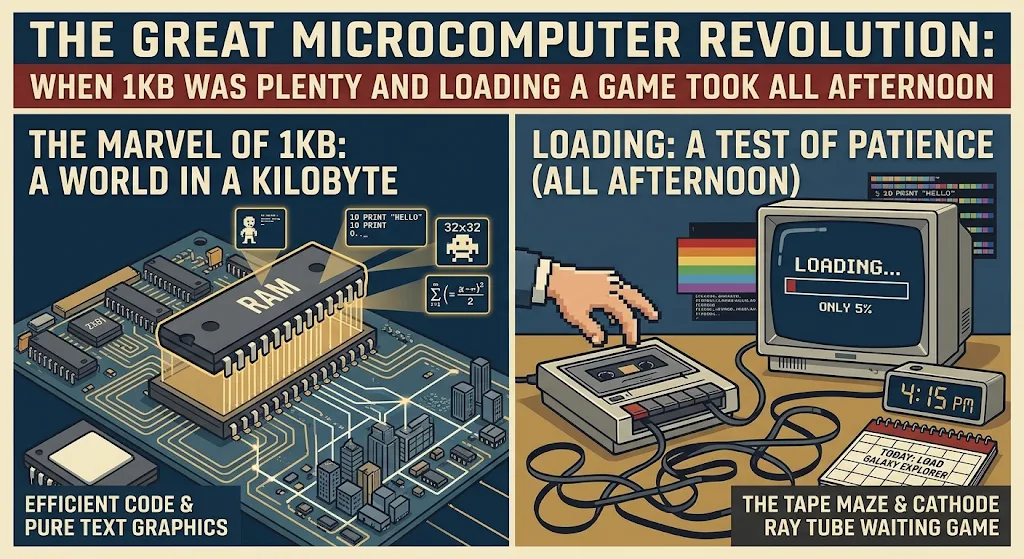
If you were around in the early 1980s, you might remember a time when computers were exciting, mysterious and, occasionally, deeply frustrating. They had strange names, strange keyboards and a remarkable ability to make perfectly sensible people stare at a television screen for twenty minutes, only to discover that their latest game had failed to load.
Welcome to the golden age of the microcomputer.
Today, we carry more computing power in our pockets than the technology that sent astronauts to the Moon. In 1982, however, owning a computer with 48KB of memory made you feel rather important. If you had 64KB, you were practically running NASA.
The early 1980s saw an explosion in affordable home computers. British manufacturers were particularly influential, with Sir Clive Sinclair leading the charge alongside Acorn, while American companies such as Commodore, Atari and Apple were developing their own contenders.
These machines promised to educate children, revolutionise business, improve productivity and, naturally, provide endless entertainment. Some delivered on those promises. Others provided an excellent education in patience.
Let’s revisit some of the most memorable machines of the period.
1. Sinclair ZX81 – The computer that started it all (1981)
The ZX81 was arguably the machine that introduced ordinary British households to computing. Priced at just £69.95 as a kit or £99.95 ready assembled, it was an extraordinary achievement in making computers affordable.
Its specifications were modest, to put it politely. It came with just 1KB of RAM. That’s 1,024 bytes. Today, a single photograph on your phone might consume several million times that amount.
The ZX81 had a rather unusual membrane keyboard, which felt less like typing and more like pressing buttons on a slightly reluctant calculator. Its black-and-white display was generated through a television connection, and it had no proper sound capability.
Pros:
- Exceptionally affordable.
- Small, compact and relatively simple.
- Introduced thousands of people to BASIC programming.
- Encouraged an entire generation to experiment with computing.
Cons:
- Just 1KB of memory.
- No colour graphics or proper sound.
- The keyboard was hardly a pleasure to use.
- Programs could be lost if the machine overheated or the memory expansion wobbled.
Nevertheless, the ZX81 was hugely influential. It demonstrated that a computer didn’t need to cost a fortune or occupy an entire office. It just needed to be affordable enough for someone to persuade their spouse that it was an essential household purchase.
2. BBC Micro – The serious contender (1981)
If the ZX81 was the people’s computer, the BBC Micro was the Rolls-Royce of British home computing.
Developed by Acorn Computers for the BBC’s Computer Literacy Project, the BBC Micro was designed to introduce the nation to computing through television programmes and educational materials.
The Model B came with 32KB of RAM, excellent BBC BASIC, impressive graphics and sound, and considerable expansion capabilities.
It was a sophisticated machine, particularly for its time. Schools adopted it enthusiastically, and it became a familiar sight in classrooms across Britain.
It also had a proper keyboard, which was a welcome relief after the ZX81. You could actually type without feeling that you were trying to operate a malfunctioning vending machine.
Pros:
- Excellent build quality and keyboard.
- Powerful and elegant BASIC programming language.
- Impressive technical capabilities.
- Strong educational and business applications.
- Expandable and well supported.
Cons:
- Expensive, costing around £399 for the Model B.
- Less accessible to families on modest incomes.
- Not as affordable for casual gaming.
- Some peripherals could cost almost as much as another computer.
The BBC Micro was arguably the finest British microcomputer of the period. It helped establish computing in schools and inspired many people to pursue careers in technology.
It was also rather good at making parents feel that buying a computer was an educational investment rather than an expensive way of playing Space Invaders.
3. Sinclair ZX Spectrum – The people’s champion (1982)
The ZX Spectrum was Sir Clive Sinclair’s great commercial success and arguably the defining British home computer of the decade.
Available initially in 16KB and 48KB versions, it offered colour graphics, sound and an affordable price. The 48KB version cost £175 at launch.
Its distinctive rubber keyboard was certainly memorable. Unfortunately, it was also rather like typing on a particularly firm bath mat.
The Spectrum’s greatest strength was its enormous games market. Developers produced thousands of titles, many of which became classics. Games such as Manic Miner, Jet Set Willy and Sabre Wulf captured the imagination of a generation.
Its colourful graphics and relatively low price made it particularly attractive to teenagers.
Pros:
- Affordable and accessible.
- Colour graphics.
- Huge games library.
- Strong programming community.
- Excellent value for money.
Cons:
- Rubber keyboard was not particularly practical.
- Limited sound capabilities.
- Colour clashes could make graphics look rather peculiar.
- Loading games from cassette tape could be painfully unreliable.
The Spectrum was not the most sophisticated machine, but it was enormously influential. It helped create Britain’s computer games industry and inspired countless young people to experiment with programming.
It also introduced a new household ritual: sitting beside the television, listening to an electronic screech for several minutes, and hoping that the computer hadn’t decided to give up.
4. Commodore 64 – The American heavyweight (1982)
If the Spectrum was Britain’s favourite, the Commodore 64 was its formidable American rival.
With 64KB of RAM, excellent graphics and the remarkable SID sound chip, the C64 was an impressive machine. It was particularly strong for gaming and entertainment.
Its sound capabilities were especially good, producing music and effects that seemed almost magical compared with the Spectrum.
It also had a proper keyboard and a distinctive beige or brown casing. It looked rather more like a serious computer than something that had escaped from a children’s toy department.
Pros:
- 64KB of RAM.
- Excellent sound capabilities.
- Impressive graphics.
- Huge software and games library.
- Strong international user community.
Cons:
- More expensive than some British alternatives.
- BASIC was relatively limited without extensions.
- Cassette loading could be slow.
- Some useful peripherals, particularly disk drives, were expensive.
The Commodore 64 eventually became the best-selling single computer model in history. It was an excellent all-round machine, combining entertainment with programming and practical applications.
For many people, it was the ultimate home computer. It could play games, produce music, teach programming and occasionally even help with homework. Although, judging by the number of hours spent playing games, homework was probably not its greatest contribution.
5. Atari 800 and 800XL – The technical show-off (1979–1983)
Atari was already famous for arcade games and home video consoles when it entered the home computer market.
Its 8-bit computers were technically impressive, with dedicated graphics and sound hardware that made them particularly good at games.
The Atari 800 was followed by machines including the 600XL and 800XL. The latter became an important competitor to the Commodore 64.
Atari’s machines offered impressive colour graphics, smooth animation and good sound. They were particularly popular in America, although they never achieved quite the same household penetration in Britain as the Spectrum or BBC Micro.
Pros:
- Excellent graphics and animation.
- Good sound capabilities.
- Strong gaming performance.
- Sophisticated hardware.
Cons:
- Less widespread software availability in Britain.
- Less familiar to the average British household.
- Some peripherals were expensive.
- Competition from Commodore was fierce.
The Atari was a technically accomplished computer, but it suffered from a problem familiar to many excellent products: being very good was not always enough to win the market.
6. Apple IIe – The business professional (1983)
While many home computers were competing for the teenage gaming market, Apple was pursuing a somewhat different audience.
The Apple IIe was a mature and capable personal computer, with 64KB of RAM, colour graphics and a strong software ecosystem.
It was particularly attractive to businesses, schools and professionals. Spreadsheet software such as VisiCalc helped establish the personal computer as a serious business tool.
The Apple II family had already built a substantial following, and the IIe continued that success.
Pros:
- Excellent business and educational software.
- Expandable architecture.
- Good keyboard and usability.
- Strong reputation and software support.
Cons:
- Expensive.
- Less accessible to ordinary households.
- Some capabilities required additional expansion cards.
- Less attractive for gaming than some dedicated entertainment-oriented competitors.
The Apple IIe demonstrated that computers were not simply expensive toys. They could help businesses manage information, perform calculations and improve productivity.
It was probably the machine most likely to be found in an office rather than a teenager’s bedroom.
7. Commodore VIC-20 – The affordable alternative (1981)
The VIC-20 was Commodore’s attempt to bring computing to a much wider audience.
It was cheaper than many of its competitors and relatively straightforward to use. With 5KB of RAM, colour graphics and sound, it was a useful entry-level machine.
It was not particularly powerful, but it was affordable and had a growing library of software.
Pros:
- Relatively inexpensive.
- Colour graphics and sound.
- Easy to get started with.
- Good introduction to BASIC programming.
Cons:
- Very limited memory.
- Restricted graphics capabilities.
- Less powerful than the C64 that followed it.
- Some software required additional memory expansions.
The VIC-20 was a sensible compromise. It wasn’t the fastest, cleverest or most sophisticated computer, but it helped make computing accessible.
In many respects, that was precisely the point.
The other great frustration: cassette tapes
It is impossible to discuss early 1980s microcomputers without mentioning the cassette recorder.
Most machines used ordinary audio cassette tapes to load and save programs. You connected a cassette recorder to the computer, pressed play and waited.
And waited.
And waited.
The process could take several minutes, sometimes longer. A slight problem with the tape alignment, volume setting or recording quality could result in failure.
The familiar loading noises became part of the experience. A strange combination of whistles, squeaks and electronic shrieking would emerge from the television speaker.
There was also the occasional temptation to use a pencil to rewind the cassette, saving precious battery power. It was hardly cutting-edge technology, but it worked.
So, which was the best?
There is no single winner because these machines were designed for different audiences.
- The BBC Micro was probably the best British all-round computer, with excellent technical capabilities and educational value.
- The ZX Spectrum offered extraordinary value and helped create a generation of programmers and games developers.
- The Commodore 64 was arguably the best overall home entertainment computer, with its superb graphics and sound.
- The Apple IIe was a serious productivity machine, while the Atari 800 was technically impressive.
- And the ZX81 deserves enormous credit for making computing affordable in the first place.
Conclusion: A revolution in 48KB
Looking back, the early 1980s microcomputer revolution was about much more than hardware specifications. It was about curiosity, experimentation and the democratisation of technology.
For the first time, ordinary people could buy a computer, take it home, connect it to their television and start learning how it worked.
There were no smartphones, no internet, no cloud computing and certainly no artificial intelligence to write your programs for you. If you wanted a computer to do something useful, you generally had to learn how to tell it yourself.
And perhaps that was the greatest achievement of the period. A generation learned to programme, experiment, solve problems and think differently about technology.
Of course, there were frustrations. The keyboards were sometimes dreadful, the graphics occasionally looked like a bad television reception, and loading a game could take longer than playing it. But we loved them.
And if you still have a soft spot for the ZX Spectrum, BBC Micro or Commodore 64, you are certainly not alone. After all, when you have grown up believing that 64KB is an impressive amount of memory, it is difficult not to be slightly suspicious of a computer claiming to have 64GB.
Some things never change.
Recent Comments