
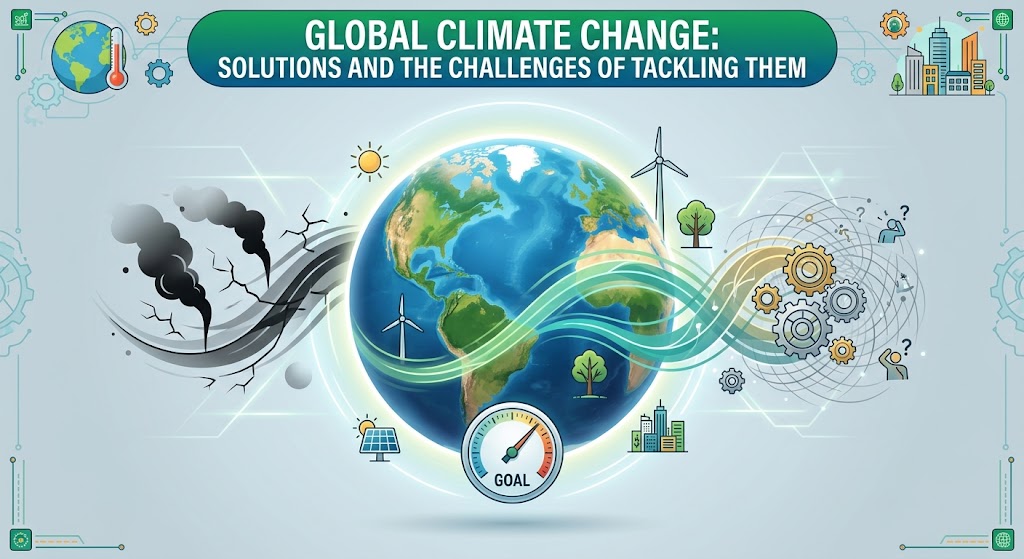
Climate change is one of the defining challenges of the twenty-first century. Although the Earth’s climate has always changed naturally, the rapid increase in global temperatures observed since the Industrial Revolution is primarily the result of human activity. The central problem is the accumulation of greenhouse gases, particularly carbon dioxide (CO₂), methane and nitrous oxide, in the atmosphere. These gases trap heat and alter the Earth’s energy balance, producing rising temperatures, changing weather patterns, melting ice, rising sea levels and increasing pressure on natural ecosystems.
Addressing climate change is therefore not a matter of finding one solution. The causes are spread across energy, transport, agriculture, industry, buildings, land use and waste. Each requires a different combination of technology, investment, regulation and changes in behaviour. Moreover, the solutions themselves create significant political and economic challenges. The following ten areas represent some of the most important sources of human-induced climate change and illustrate why reducing global emissions is considerably more complicated than simply agreeing that climate change needs to be addressed.
1. Burning Fossil Fuels
The most important driver of modern climate change is the burning of coal, oil and natural gas. Fossil fuels remain deeply embedded in the global economy, providing electricity, heating, transport and industrial energy. When they are burned, carbon that has been stored underground for millions of years is released into the atmosphere as CO₂.
The principal solution is to reduce dependence on fossil fuels and replace them with lower-carbon sources of energy, including renewable electricity from wind and solar, nuclear power, hydroelectricity and potentially other emerging technologies. Electricity grids also need to become more flexible, with greater use of energy storage, interconnection and demand management.
The difficulty is that fossil fuels remain relatively convenient, energy-dense and, in many countries, economically important. Millions of people work directly or indirectly in fossil-fuel industries, while governments collect substantial tax revenues from them. Developing countries also argue that wealthy nations industrialised using fossil fuels and therefore have a greater responsibility to finance the transition. Rapidly eliminating fossil fuels could also increase energy prices or threaten energy security if alternative capacity is not developed quickly enough.
2. Deforestation
Forests absorb CO₂ from the atmosphere and store carbon in trees, vegetation and soils. When forests are destroyed, some of that stored carbon is released, while the planet simultaneously loses an important mechanism for absorbing future emissions. Deforestation is particularly significant in tropical regions where forests are cleared for agriculture, cattle production, timber and other commercial activities.
The most straightforward response is to protect existing forests, discourage illegal logging and provide economic incentives for reforestation and sustainable forestry. Governments could also introduce stronger land-use controls and encourage agricultural productivity to increase without requiring continual expansion into forested areas.
The challenge is that forests often have substantial economic value. A farmer clearing land may receive an immediate financial benefit from growing crops or raising cattle, whereas the climate benefits of preserving the forest are global and long-term. This creates a classic economic problem: the person or country protecting the forest may bear the cost while the benefits are enjoyed by the entire world. International mechanisms that financially reward countries for preserving forests could therefore be important, but require considerable funding, monitoring and political cooperation.
3. Agriculture and Livestock
Agriculture contributes to climate change through methane from livestock, nitrous oxide from fertilisers and land-use changes associated with food production. Cattle are particularly significant because methane is a powerful greenhouse gas, while intensive fertiliser use produces nitrous oxide.
There are several potential solutions. Farmers can improve fertiliser efficiency, adopt regenerative or lower-emission farming practices, improve livestock feed, reduce methane emissions and develop alternative sources of protein. Technologies such as methane-reducing feed additives could potentially reduce emissions from cattle without requiring the complete elimination of livestock farming.
However, agriculture is politically and culturally sensitive. Food is fundamental to human life, and governments are understandably reluctant to impose policies that significantly increase food prices. Farmers also operate within tight financial margins and may not have the resources to invest in new technologies. Furthermore, dietary change is difficult because food preferences are deeply embedded in culture. Policies that attempt to reduce meat consumption can therefore generate significant political resistance.
4. Electricity and Heat Generation
Electricity generation is closely linked to fossil-fuel consumption but deserves separate consideration because of its central role in the modern economy. Coal and gas-fired power stations generate substantial emissions, particularly in countries where electricity demand is growing rapidly.
Decarbonising electricity requires a large expansion of low-carbon generation. Wind and solar power have become increasingly important, while nuclear power provides low-carbon electricity without depending on weather conditions. Battery storage, grid reinforcement and technologies such as hydrogen could also help address the intermittency of renewable generation.
The principal challenge is scale. Global electricity demand is likely to continue increasing as populations grow and economies become more electrified. Electric vehicles, heat pumps and industrial electrification may actually increase electricity demand even while reducing overall emissions. Governments therefore have to build new generation and grid infrastructure while simultaneously retiring high-emission assets. This requires enormous investment and long-term policy stability, something that can be difficult to achieve within short political election cycles.
5. Transport
Transport remains heavily dependent on oil. Cars, trucks, ships and aircraft consume large quantities of petrol, diesel and aviation fuel. Road transport can increasingly be electrified, while public transport, cycling and rail can reduce dependence on private vehicles. Electric vehicles are already an important part of this transition.
The more difficult sectors are aviation, shipping and heavy-duty transport. Batteries may not be practical for every long-distance aircraft or ship, meaning that alternative fuels such as sustainable aviation fuels, hydrogen or ammonia may become necessary.
The political challenge is that transport policies directly affect people’s everyday lives. Higher fuel taxes, restrictions on petrol and diesel vehicles or measures that discourage car ownership can be politically unpopular, particularly in rural areas where alternatives to private vehicles may be limited. There is also a significant economic challenge in ensuring that lower-income households are not disproportionately affected by the transition.
6. Industry and Manufacturing
Heavy industry is another major source of greenhouse-gas emissions. Cement production, steel manufacturing, chemicals and other industrial processes often require extremely high temperatures that are difficult to achieve without fossil fuels. Cement also produces CO₂ through the chemical transformation involved in manufacturing it.
Addressing industrial emissions will require a combination of electrification, renewable energy, hydrogen, more efficient manufacturing processes, alternative materials and carbon capture and storage. Steel production, for example, can increasingly move towards hydrogen-based processes, while carbon capture may have an important role in sectors where emissions are particularly difficult to eliminate.
The major obstacle is cost. Industrial companies compete in global markets, so if one country imposes significantly higher environmental costs than its competitors, production may simply move elsewhere. This phenomenon, sometimes called carbon leakage, creates a difficult policy dilemma. Governments need to reduce emissions without destroying domestic industries or making their economies uncompetitive.
7. Buildings
Buildings contribute to climate change primarily through heating, cooling and electricity consumption. In colder countries, heating can represent a significant proportion of energy demand, particularly where homes depend on gas or oil boilers.
The solution involves improving insulation, increasing energy efficiency and replacing fossil-fuel heating systems with technologies such as heat pumps. New buildings can also be designed to require considerably less energy.
The problem is that upgrading millions of existing buildings is expensive and disruptive. Homeowners may not want to spend large sums on insulation or heating systems when the financial return takes many years to materialise. Governments can provide grants and incentives, but these require public money. There is also a political challenge in regulating privately owned homes, particularly if environmental standards require substantial expenditure by households.
8. Oil and Gas Extraction and Methane Leakage
The climate impact of fossil fuels does not end when they are burned. Oil and gas production can release methane through leaks, venting and other operational processes. Methane has a much stronger warming effect than CO₂ over shorter periods, meaning that reducing methane emissions can produce relatively rapid climate benefits.
Governments can introduce stronger monitoring requirements, require companies to repair leaks and prohibit unnecessary methane venting and flaring. Modern satellite technology and sensors can also make it increasingly possible to identify major methane leaks.
The challenge is enforcement. Oil and gas production occurs across countries with very different regulatory standards. Some governments may be reluctant to impose expensive requirements on domestic producers, particularly where fossil-fuel revenues are important to national budgets. International cooperation and transparent monitoring are therefore essential.
9. Waste and Landfill
Waste is often overlooked, but decomposing organic material in landfill sites can generate methane. Waste treatment, transport and disposal also consume energy and can generate emissions.
The most effective approach is to reduce waste in the first place, increase recycling and reuse, compost organic material and capture methane from landfill sites. A more circular economy, where materials are reused rather than discarded, could reduce both emissions and demand for raw materials.
The challenge is largely economic and behavioural. Recycling systems require investment and consumers need to change how they purchase, use and dispose of products. Companies may also resist requirements that increase packaging or production costs. Waste therefore illustrates an important broader point: climate policy is not simply about large power stations and industrial facilities; it increasingly involves millions of individual decisions.
10. Land Use, Ecosystem Degradation and Soil Loss
Beyond deforestation, changes in land use can release carbon from soils, wetlands and other ecosystems. Urbanisation, agricultural expansion, wetland destruction and soil degradation can all reduce the Earth’s capacity to store carbon.
Solutions include restoring wetlands, improving soil management, planting trees, protecting natural ecosystems and developing more sustainable agricultural systems. These measures can also provide benefits beyond climate change, including improved biodiversity, water management and soil quality.
The difficulty is competition for land. The same land may be valuable for agriculture, housing, infrastructure, conservation or carbon storage. Governments therefore face difficult choices about how land should be used. There is also a risk that poorly designed policies could result in large-scale tree planting that damages biodiversity or competes with food production.
The Political and Economic Challenge
Although the technological solutions to climate change are increasingly available, implementing them on a global scale is much harder. Climate change is fundamentally a collective-action problem. No individual country can solve it alone because greenhouse gases mix throughout the atmosphere. A country can spend billions reducing its own emissions while still experiencing the effects of emissions produced elsewhere.
There is also a fundamental question of fairness. Developed countries have historically produced a much larger proportion of cumulative emissions, while many developing countries argue that they should be allowed to increase their energy consumption as their populations become wealthier. At the same time, countries such as China and India are now among the world’s largest annual emitters, meaning that future climate policy cannot succeed without their participation.
The transition also involves winners and losers. Renewable energy, electric vehicles, battery manufacturing and other green industries can create new jobs and investment. However, coal mining, oil production and some traditional industrial activities may decline. Regions economically dependent on these industries may therefore resist change. Governments need policies that support affected workers and communities rather than simply assuming that new industries will automatically replace old ones.
There is also the issue of political time horizons. Climate change is a long-term problem, whereas democratic governments often operate on four- or five-year electoral cycles. The benefits of reducing emissions may not become fully apparent for decades, while the costs of doing so can be immediate. Politicians therefore face an incentive to postpone difficult decisions, particularly where voters experience higher energy, transport or food costs as a direct consequence.
Conclusion
The causes of climate change are diverse, but they share a common underlying factor: the modern global economy has been built around the consumption of fossil fuels and the intensive use of natural resources. Addressing climate change therefore requires more than simply replacing petrol cars with electric vehicles or building more wind turbines. It requires a broad transformation of energy production, transport, agriculture, industry, buildings and land use.
The encouraging development is that many of the necessary technologies already exist or are developing rapidly. Renewable electricity, batteries, electric vehicles, heat pumps, methane monitoring, carbon capture, low-carbon industrial processes and improved agricultural techniques can all contribute to reducing emissions. The central question is increasingly less about whether solutions exist and more about whether governments, businesses and consumers can deploy them quickly enough and at an acceptable economic and social cost.
Ultimately, the greatest challenge may not be technological but political. Governments must persuade populations to accept significant changes while ensuring that the transition does not disproportionately harm poorer households, workers or developing countries. Businesses need sufficiently stable policies to justify long-term investment, while international institutions need to encourage countries to cooperate rather than free-ride on the efforts of others.
Climate change is therefore both an environmental problem and an economic, political and social one. The most successful response is unlikely to come from a single policy or technology. It will require a combination of technological innovation, investment, market incentives, regulation, international cooperation and behavioural change. The difficulty is considerable, but the alternative, allowing emissions to continue rising while the economic and environmental consequences accumulate, would ultimately create an even greater challenge for future generations.
Recent Comments