
Introduction
The UK defined benefit (DB) pension system is undergoing one of the most significant transformations in its history. For much of the last two decades, the dominant narrative was one of pension deficits, rising costs for employers and concern about whether schemes would ultimately be able to meet their promises. Today, the picture is very different. Higher interest rates, stronger funding positions and changes in investment strategies have left a large proportion of DB schemes in surplus, shifting the central question from how to repair deficits to how schemes should reach their long-term endgame.
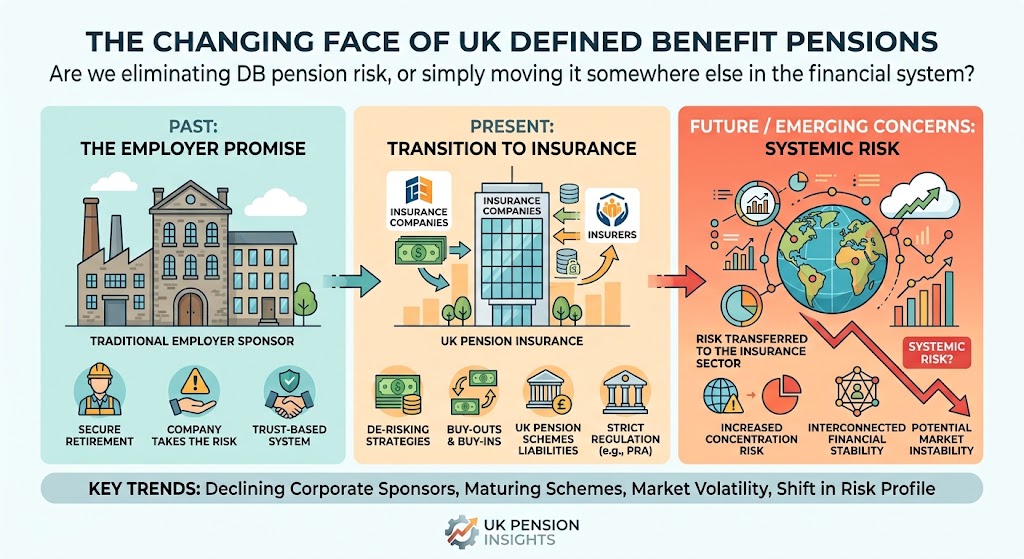
This has created growing interest in buy-ins, partial buy-ins, buy-outs, consolidation and run-on strategies. At the same time, the enormous transfer of pension liabilities to insurance companies raises a new question: are we eliminating pension risk, or simply moving it somewhere else in the financial system?
A brief history of DB pensions
The traditional DB pension was built around a relatively simple promise. An employee worked for an employer, accumulated pension benefits based largely on salary and length of service, and expected to receive a predetermined income in retirement. The employer and pension scheme took responsibility for ensuring that sufficient assets were available to meet those future payments.
For many years this model worked relatively well. Investment returns were expected to provide a significant part of the funding, while employers ultimately stood behind the pension promise.
However, the economics became increasingly difficult. People lived longer, pension liabilities therefore extended further into the future, interest rates fell, and the cost of providing guaranteed benefits increased. At the same time, investment markets became more volatile and regulatory and accounting requirements placed greater emphasis on accurately recognising pension liabilities.
Many schemes consequently developed significant deficits. Employers were required to make additional contributions, while trustees increasingly sought to reduce investment risk. Liability-driven investment (LDI) became an important part of this evolution, allowing schemes to hedge interest-rate and inflation exposure more effectively.
The 2022 gilt crisis demonstrated both the value and vulnerability of this approach. Rapid increases in gilt yields created enormous collateral demands for leveraged LDI strategies, forcing schemes to sell assets into a stressed market. The episode demonstrated that pension schemes were not isolated long-term investors: collectively, their actions could have consequences for the wider financial system.
Since then, the environment has changed substantially. Higher interest rates have reduced the present value of pension liabilities, while many schemes have retained substantial asset values. TPR’s 2026 analysis estimates that around 90% of DB schemes are in surplus on a technical-provisions basis, around 80% on a low-dependency basis and around 60% on a buy-out basis.
This represents a fundamental change in the economics of DB pensions.
The future of DB pensions
The future of DB pensions is therefore less about managing deficits and more about managing the endgame.
There are several possible destinations. A scheme can ultimately buy out its liabilities with an insurer, transfer them to another form of consolidator, or remain in existence and run on with a low-risk investment strategy. The emergence of surplus also means trustees and sponsors are increasingly considering whether there is economic value in retaining the scheme rather than immediately transferring it to an insurer.
The future is therefore unlikely to involve every scheme taking the same route. Instead, different schemes will follow different journeys depending on their funding position, sponsor strength, membership profile and investment strategy.
Why are schemes considering buy-ins and buy-outs?
A buy-in is essentially an institutional annuity. The pension scheme pays an insurer a premium and receives an insurance policy designed to cover specified pension benefits. The scheme continues to exist and normally continues to pay its members, but the insurer has taken on the economic risks associated with the insured benefits.
Importantly, a buy-in does not have to cover the whole scheme. A partial buy-in allows trustees to insure only a proportion of the liabilities.
For example, a scheme might have £1 billion of pension liabilities and decide to buy in £400 million. The insurer would provide insurance covering the agreed £400 million of benefits, while the remaining £600 million of liabilities would continue to be managed by the DB scheme.
The cash-flow structure would broadly be:
Insurer → DB scheme → pensioners
The insurer provides the money associated with the insured benefits, while the scheme continues to make the pension payments to members. The pensioner therefore continues to receive the pension promised by the scheme.
This provides trustees with a powerful mechanism forgradual de-risking.
A scheme might initially insure 20% or 30% of its liabilities, subsequently undertake further buy-ins and eventually reach a position where substantially all of its liabilities are insured. The final stage can then be a buy-out, after which the scheme can ultimately be wound up.
Partial buy-ins can therefore provide a bridge between a traditional DB investment strategy and the ultimate insurance endgame.
Why would a scheme use a partial buy-in?
There are several reasons.
First, it allows the scheme to lock in risk reduction without having to fund a complete buy-out immediately. A scheme may have sufficient assets to insure a significant portion of its liabilities but not enough to complete the whole transaction.
Second, trustees can potentially target particular groups of members. For example, they may choose to insure current pensioners first, while continuing to manage deferred members within the scheme.
Third, partial buy-ins allow trustees to take advantage of attractive insurance pricing when it becomes available. Rather than waiting several years for the scheme to reach full buy-out funding, trustees can secure part of the liabilities today.
Finally, partial buy-ins can reduce the amount of investment and longevity risk remaining within the scheme. Once a group of liabilities has been insured, the trustees no longer have to manage the same level of risk associated with those benefits.
The objective is therefore not necessarily to maximise investment returns. It may instead be to generate sufficient additional funding to complete the journey to buy-out while avoiding unnecessary investment risk.
Buy-in versus buy-out
The distinction is important.
With a buy-in, the insurer provides insurance to the pension scheme. The scheme remains responsible for administering the pension benefits and generally continues paying pensioners.
With a buy-out, the insurer takes responsibility for the benefits and the pension scheme can ultimately be wound up.
The journey can therefore look like:
DB scheme → Partial buy-in → Further buy-in → Full buy-in → Buy-out → Scheme wind-up
This staged approach is increasingly relevant as schemes become better funded.
But buy-out is not necessarily the inevitable destination
A well-funded DB scheme does not necessarily have to buy out.
If a scheme has sufficient assets to meet its liabilities and can operate with a low-risk investment strategy, trustees may decide that run-on provides a better long-term outcome.
This could allow the scheme to retain some of the economic value of a surplus rather than transferring it to an insurer.
The regulatory environment is increasingly recognising this possibility, with greater flexibility around surplus and greater consideration of different DB endgame strategies.
Trustees therefore increasingly have a choice:
1 – Buy-in: transfer some or all of the risk while retaining the scheme.
2 – Buy-out: transfer the liabilities and ultimately wind up the scheme.
3 – Run-on: retain the scheme and manage the assets and liabilities over the longer term.
The optimal answer will vary between schemes.
The emerging systemic challenge
There is, however, an irony at the heart of the buy-out revolution.
The original problem was that millions of pension promises were spread across thousands of pension schemes, each with different trustees, sponsors, investment strategies and risk-management capabilities. Buy-out appears to solve this problem by transferring those liabilities to highly regulated insurance companies.
But what happens if a very large proportion of the UK’s DB liabilities ultimately end up with a relatively small number of insurers?
The risk may become more concentrated.
Instead of thousands of pension schemes managing pension liabilities, a much smaller number of major insurers could become responsible for hundreds of billions of pounds of obligations.
This does not necessarily mean that buy-out makes the system less safe. Insurers are highly regulated financial institutions with significant capital requirements, sophisticated risk-management systems and regulatory supervision.
Indeed, transferring risks from individual pension schemes to professional insurers could make the system more resilient.
But concentration creates different risks.
Asset and investment concentration
Insurers backing large annuity books need to invest enormous amounts of capital in assets that generate long-term cash flows. This can create significant exposure to corporate bonds, private credit, infrastructure, property, mortgages and other illiquid assets.
If many insurers pursue similar investment strategies, a major economic shock could affect several institutions simultaneously.
This is particularly important because the UK pension system is increasingly becoming connected to private markets. The transfer of DB liabilities to insurers could therefore change not only who carries pension risk but also where pension money is invested.
Reinsurance and the internationalisation of pension risk
A further development is the growing use of reinsurance.
UK insurers can transfer some of the risks associated with bulk annuity transactions to reinsurers, including overseas reinsurers. This can allow insurers to write more business and manage their capital more efficiently.
However, it also creates another layer in the risk chain:
Pension scheme → UK insurer → reinsurer → global investment markets
The ultimate pension promise can therefore become part of an increasingly complex international network of insurers, reinsurers and investment vehicles.
The PRA has consequently been paying increasing attention to funded reinsurance and the resilience of the insurance sector.
The long-term systemic question
The fundamental question is therefore whether the UK is genuinely eliminating pension risk or merely transferring it.
For an individual pensioner, the answer may be reassuring. A buy-out can provide considerable certainty that their pension will continue to be paid according to the insurance contract.
For the pension scheme trustee, the transaction can be equally attractive. It removes a substantial amount of uncertainty and can allow the scheme to reach its endgame.
For the financial system, however, the answer is more complicated.
The risk has moved from pension schemes to insurers, and from insurers partly to reinsurers and capital markets. The assets backing these promises may include increasingly complex and illiquid investments. The more interconnected the system becomes, the more important it is that regulators understand not only the individual solvency of each institution but also the connections between them.
The experience of the 2022 LDI crisis provides an important warning. A collection of individually sensible investment decisions can collectively create systemic consequences when institutions behave similarly at the same time.
The same principle could apply to the insurance market.
Conclusion
The history of UK DB pensions is therefore a story of evolution from employer-backed pension promises, through decades of deficits and de-risking, towards a new era of stronger funding positions and endgame management.
Buy-ins, particularly partial buy-ins, provide trustees with a flexible way of transferring risk progressively. Rather than having to move directly from an uninsured DB scheme to a complete buy-out, trustees can insure portions of their liabilities, reduce risk and gradually move towards their ultimate endgame.
Buy-outs are attractive because they provide something trustees increasingly value above investment returns: certainty. Once a scheme is sufficiently well funded, transferring pension liabilities to an insurer can remove investment, longevity and other risks and provide a clear route to closure.
But the success of buy-out creates its own challenge. If hundreds of billions of pounds of pension liabilities are transferred to a relatively small insurance and reinsurance ecosystem, the UK may create a new concentration of financial risk.
The future of DB pensions is therefore unlikely to be simply about eliminating risk. It will be about where risk resides, how it is connected and whether the institutions carrying it have sufficient capital, liquidity and diversification to withstand a major financial shock.
The ultimate paradox is that the UK may successfully solve the traditional DB pension problem, the risk that individual schemes cannot meet their promises, while simultaneously creating a new systemic question:
If we transfer almost all of the UK’s DB pension risk to insurers, who ultimately carries the risk when the whole financial system is under stress?
Recent Comments