
Introduction: A World on the Brink
By the early 1980s, the Cold War between the United States and the Soviet Union had entered a particularly dangerous phase. Following a period of relative détente during the 1970s, relations had deteriorated sharply. The Soviet invasion of Afghanistan in 1979, the election of Ronald Reagan in 1980, increasing military expenditure, and the deployment of new nuclear missiles in Europe had heightened tensions between the two superpowers.
Both countries possessed enormous nuclear arsenals, capable of destroying each other many times over. Their security depended largely on the doctrine of Mutually Assured Destruction (MAD): the understanding that any nuclear attack would trigger devastating retaliation. It was against this background that, in March 1983, President Reagan announced one of the most ambitious military technology programmes in history: the Strategic Defence Initiative (SDI), popularly known as Star Wars.
What Was SDI?
Reagan wanted to move beyond relying exclusively on nuclear deterrence and develop a defensive shield capable of protecting the United States against a Soviet nuclear missile attack.
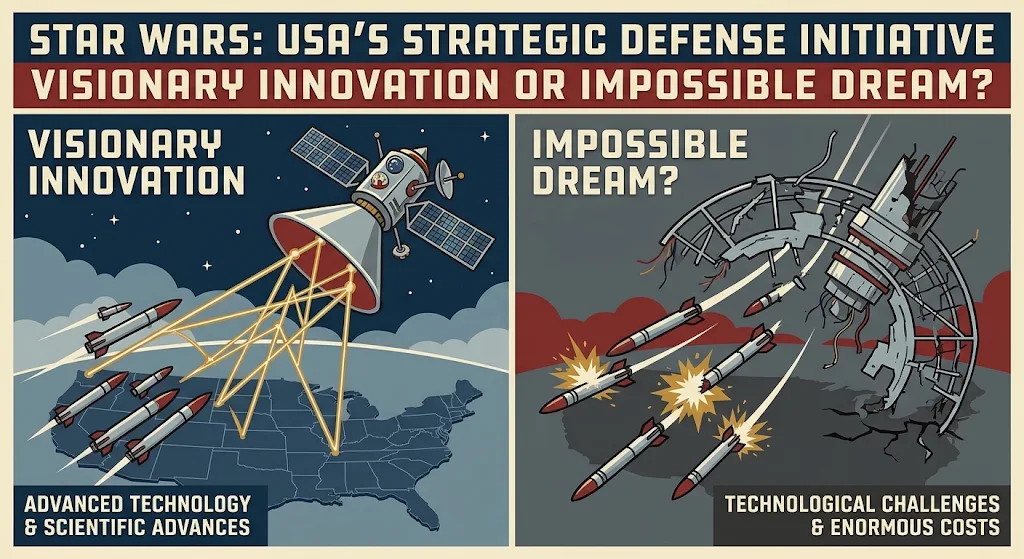
SDI envisaged a multi-layered system using satellites, lasers, radar and interceptor missiles. Satellites would detect incoming missiles shortly after launch, track their trajectories and attempt to destroy them at different stages of flight. Some proposals involved space-based lasers and satellite interceptors, while others relied on ground-based missile defence.
The ambition was revolutionary: rather than threatening retaliation, America would seek to make a nuclear attack ineffective.
The Good Points
SDI was visionary in its ambition and accelerated research into technologies that subsequently influenced defence, computing, surveillance and missile detection.
Its principal attraction was the possibility of protecting civilian populations rather than simply threatening an aggressor with devastating retaliation. It also challenged the assumption that nuclear security had to depend entirely on the threat of mutual destruction.
Politically, SDI placed additional pressure on the Soviet Union. Its economy was already struggling, and matching America’s investment in advanced military technology would be extremely expensive. Some historians argue that SDI increased the pressure on Moscow to negotiate over nuclear weapons.
The Bad Points
Despite its ambition, SDI faced enormous technical challenges. Intercepting thousands of nuclear warheads travelling at extraordinary speeds, potentially accompanied by decoys, was an exceptionally difficult proposition. Even a system that destroyed 95% of incoming warheads would leave the remaining 5% capable of causing catastrophic devastation.
The financial implications were also substantial, with the prospect of hundreds of billions of dollars in research, development and deployment costs.
There were serious geopolitical concerns too. Soviet leaders viewed SDI as a potential threat to the existing nuclear balance. If America could protect itself from retaliation, it might theoretically gain the ability to launch a first strike. Rather than making the world safer, SDI could therefore encourage a new arms race, with the Soviet Union developing additional missiles and countermeasures to overwhelm American defences.
Summary: Revolution or Fad?
SDI was an extraordinary technological vision, but its original ambition was never realised. The United States did not develop the comprehensive nuclear shield envisaged by Reagan, and many of the technologies proved considerably more difficult to implement than anticipated.
Nevertheless, SDI should not be dismissed as simply an expensive failure. It stimulated technological innovation, influenced subsequent missile defence programmes and became an important element of Cold War diplomacy.
Perhaps its greatest achievement was not the creation of an impenetrable defensive shield, but the way it challenged conventional thinking about nuclear deterrence and influenced the strategic calculations of both superpowers.
SDI ultimately demonstrated that ambitious technological innovation can reshape military strategy and international relations, even when the original vision proves beyond practical reach.
Recent Comments